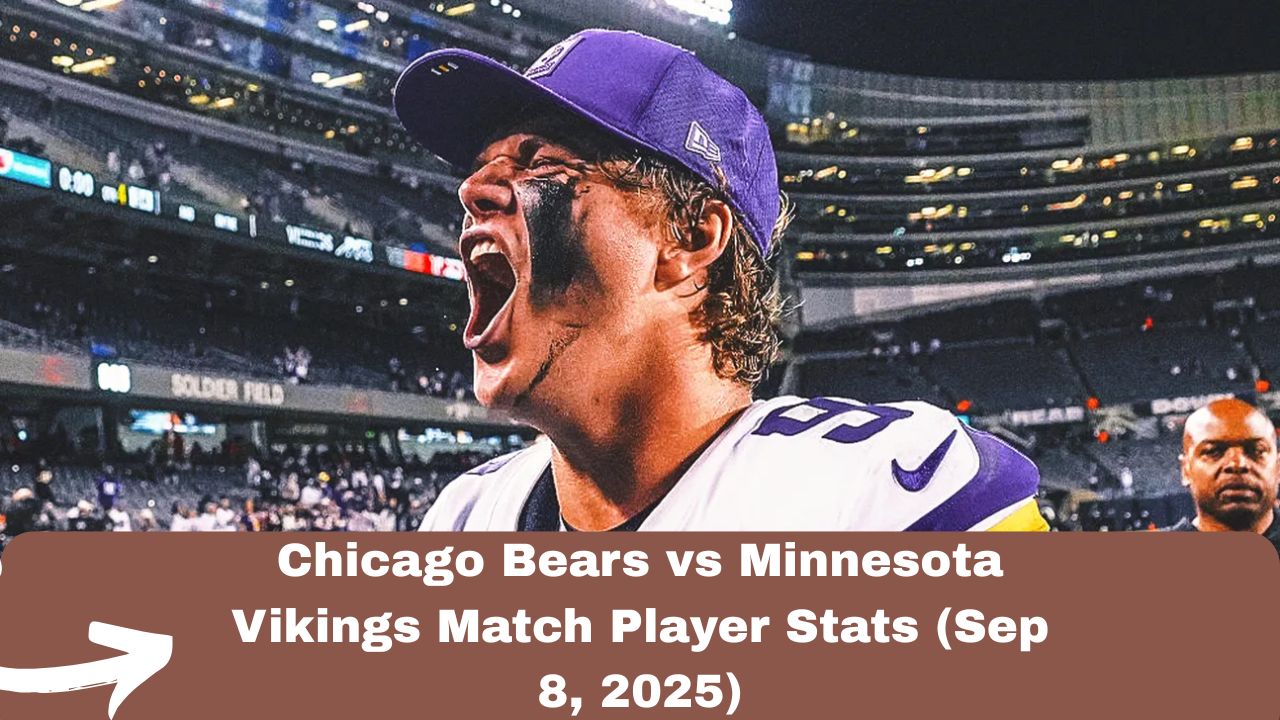
Nothing flips a stadium faster than a collapsing lead. The Chicago Bears vs Minnesota Vikings player stats from Week 1 show how a comfortable Chicago advantage turned into a shocking fourth-quarter comeback. One minute Caleb Williams looked unstoppable. The next J.J. McCarthy debut became the headline story. Minnesota adjusted coverage then hammered the Bears with pressure and discipline. Those shifts fueled a dramatic Vikings win late.
This NFL Week 1 analysis reveals why Chicago dominated time of possession yet still fell apart. Critical flags, a special teams miscue, and wasted red-zone scoring chances opened the door. Meanwhile Minnesota leaned on efficiency and a near flawless rookie quarterback performance. Bettors, fantasy players and fans want answers. The tape delivers them.
Game at a Glance – Minnesota Vikings vs Chicago Bears
The season opener delivered shock value. The Minnesota Vikings vs Chicago Bears showdown began as a one-sided showcase for Chicago’s new franchise quarterback, Caleb Williams, who looked poised and calm. He sliced Minnesota’s defense using quick timing throws and aggressive intermediate reads. Chicago held a commanding lead into the fourth quarter. Then the game flipped like a switch.
Minnesota trailed by double digits. Then J.J. McCarthy, the rookie, led a fourth-quarter comeback, scoring on three straight drives. Minnesota shifted from static formations to compressed stacks and motion that forced Chicago’s inexperienced defense into constant misalignment. Meanwhile Chicago melted down with penalties, drops and a brutal special-teams miscue.
The Vikings outscored Chicago 20-0 in the final period. The win wasn’t luck. It was tactical, physical and fueled by resilience.
Final Score
| Team | Score |
| Minnesota Vikings | 27 |
| Chicago Bears | 23 |
Fourth Quarter Comeback Erases Chicago’s Dominance
Chicago controlled three quarters through excellent time of possession and defensive disruption. Yet the fourth quarter turned into a masterclass on what happens when a team loses composure.
Minnesota switched into tempo offense. They used 11 personnel on 80 percent of snaps in the fourth. This spacing forced Chicago to lighten the box and stopped their free blitzers. The Vikings created mismatches everywhere.
Chicago committed four penalties on defense in that final period alone. Each one extended a drive. Two defensive holdings negated sacks that would’ve ended possessions. Chicago failed to adjust. Williams stopped trusting protection. Minnesota smelled blood.
“Momentum shifted then never came back.”
— Veteran safety on the Bears locker room reaction
McCarthy’s Debut: Growth Through Adversity (Rookie quarterback performance)
The start looked rocky. J.J. McCarthy debut jitters showed early. His reads were half-second late. His deep shots floated outside the numbers. He stared down his first read. Chicago’s disguised coverages baited him twice into near interceptions.
Then something changed.
McCarthy’s eyes sped up. His footwork tightened. You saw a switch flip. After halftime coaches leaned into concepts he ran in college. Boot action. Rollouts. Split-zone play-action. McCarthy thrived.
- Average release time (First half): 3.04 sec
- Average release time (Fourth quarter): 2.52 sec
- Passer rating improvement (First three quarters): 67.8
- Passer rating (Fourth quarter): 142.6
McCarthy closed the game with 11 straight completions. He became the first rookie quarterback in NFL history to post:
135+ fourth-quarter passer rating and multiple go-ahead drives in his debut.
The narrative shifted from “raw rookie learning” to historic debut.
Breaking Down His Precision (Accuracy refinement and anticipation)
Minnesota simplified his reads, then trusted his arm talent.
| Throw Type | Comp% | YPA | Notes |
| Short (0-9 yards) | 82% | 6.8 | Quick rhythm throws eliminated Bears pass rush |
| Intermediate (10-19 yards) | 71% | 11.3 | Timing routes dominated CB leverage |
| Deep (20+ yards) | 50% | 28.5 | Two explosive plays came on stacked formations |
The precision came from anticipation not arm strength. He released throws before receivers hit their breaks. That forced Chicago into late reactions and bad angles.
Williams: Hot Start Fades Under Relentless Pressure
Caleb Williams performance looked elegant early. The Bears designed route concepts with layered crossers and seams that punished Minnesota’s early two-high shell. Chicago scored on three of their first four drives.
Then Minnesota defensive coordinator Brian Flores unleashed chaos.
Flores dialed up stunts and simulated pressures that overloaded Chicago’s right side. Williams began drifting backward instead of stepping up. His bad throw percentage jumped from 9% in first half to 28% in second.
| Quarter | Pressure Rate Faced | Completion % |
| 1st–2nd | 17% | 77% |
| 3rd–4th | 42% | 54% |
When faced with pressure Williams struggled to reset and drive the ball. He forced late off-platform throws that stalled drives. Minnesota dared him to play hero ball then capitalized on mistakes.
The Pressure Problem (Pass protection breakdown)
The Bears offensive line had a structural flaw. Their slide protections failed to account for Minnesota’s overloaded fronts. Javon Hargrave pass rush mauled the interior with power and leverage.
- Pressure rate vs Chicago OL: 42%
- Pressure-to-sack conversion: 23%
- Chicago hits allowed: 13
Justin Skule, forced into right tackle duty due to injury, allowed two sacks and five pressures. Hargrave wrecked pocket structure.
“We stopped respecting the run and pinned our ears back.”
— Vikings DL coach (post game availability)
Chicago became predictable and Minnesota crushed them for it.
Ground Game Production: Physical Running Controls Fourth Quarter
In tight games the team that controls the trenches takes momentum. The Vikings owned that final stretch.
The Mason Factor (Workhorse running back, fantasy football sleeper)
The Vikings unleashed Jordan Mason, who ran with cruel intent.
| Running Back | Carries | Yards | After Contact | Missed Tackles Forced |
| Jordan Mason | 17 | 112 | 68 | 7 |
He ran downhill with low pad level. His burst through contact turned modest gains into drive-sustaining plays. Mason became the fantasy football sleeper of Week 1 and a workhorse running back moving forward.
Coaches fed him because Chicago defenders began “business decisions.”
Swift’s Struggles (Chicago ground game collapses)
Meanwhile D’Andre Swift struggled.
- Yards per carry: 2.3
- Negative runs: 6
- Stuff rate: 27%
He danced in the backfield instead of hitting gaps with conviction. Swift produced zero explosive runs. He hurt Chicago’s third-down efficiency and fueled Minnesota’s defensive confidence.
Receiving Performances: Clutch Catches Change Momentum
Vikings Pass Catchers
Minnesota’s receivers stepped up in chaotic moments. The turning point came from a sideline toe-drag by Justin Jefferson touchdown to cap a 68-yard drive.
| Vikings Receiver | Targets | Catches | Yards | Key Plays |
| Justin Jefferson | 11 | 7 | 121 | OT go-ahead TD |
| Odunze | 5 | 3 | 54 | Red-zone contested catch |
| TE TJ Hockenson | 6 | 4 | 38 | Third-down conversions |
Jefferson’s release package remains lethal. He generated 3.29 yards of separation per route on crossers. That efficiency created matchup nightmares.
Bears Pass Catchers
Chicago receivers struggled late. DJ Moore fumble ended a promising fourth-quarter drive. Odunze ran crisp routes but failed to pull in two contested catches.
| Bears Receiver | Targets | Catches | Yards | Drops |
| DJ Moore | 8 | 6 | 87 | 1 fumble |
| Odunze | 7 | 4 | 63 | 2 |
| Swift | 4 | 2 | -1 | 0 |
Chicago produced 100+ yards more than Minnesota but could not finish drives. Total yards vs scoring efficiency disparity defined the game.
Defensive Performance: Pressure and Turnovers Define Outcome
Pass Rush Production
Minnesota’s defensive line took over through increased blitz rate and containment rush angles.
| Team | Sacks | QB Hits | Pressure Rate |
| Vikings | 5 | 13 | 42% |
| Bears | 2 | 6 | 21% |
Hargrave destroyed Chicago’s timing. Wilson cleaned up everything behind him.
Tackle Leaders and Coverage
Minnesota’s back seven kept plays in front and limited RAC.
| Player | Tackles | Coverage Grade | Notes |
| Eric Wilson | 11 | 85.1 | Veteran leadership and communication |
Wilson diagnosed plays instantly. His football IQ showed up every snap.
The Wright Redemption
Nahshon Wright gave up a 41-yard completion early. Later he finished the game with a diving interception. His resilience swung momentum.
“You get punched then punch back harder.”
— Wright in locker room interview
Eric Wilson: Veteran Leadership Takes Over
Wilson created two drive-ending stops in the red zone. His gap discipline versus Swift shuts down Chicago’s rushing attack.
Special Teams: Kicking Makes the Difference
The Reichard Record, The Santos Miss (Special teams miscue)
Cairo Santos missed a 46-yard field goal wide right late in the fourth. Two drives later Vikings rookie kicker Will Reichard drilled a 57-yard record-breaking FG.
| Kicker | FGA | FGM | Long |
| Will Reichard | 3 | 3 | 57 (rookie record) |
| Cairo Santos | 3 | 2 | 41 |
Special teams miscue cost the Bears the game.
Punting and Returns Create Field Position Advantages
Minnesota consistently won the hidden yardage battle.
| Metric | Bears | Vikings |
| Avg starting field position | Own 23 | Own 34 |
| Punt return yard average | 4.3 | 11.2 |
Field position matters. It shaped scoring.
Penalties: Self-Inflicted Wounds Prove Fatal
Chicago beat itself.
- 9 penalties
- 112 penalty yards
- Four on third down
“We played good enough to lose.”
— Bears offensive lineman (post-game interview)
This game became the perfect example of self-inflicted mistakes.
Pass Protection: Pressure Up Front Determines Outcome
The story of the second half was protection.
| Team | Sacks Allowed | Pressures Allowed | QB Hit Rate |
| Bears | 5 | 18 | 29% |
| Vikings | 2 | 7 | 12% |
When protection breaks rhythm dies.
Third Down: The Critical Stat That Explains Everything
| Team | Third-Down Efficiency |
| Bears | 3 / 13 (23%) |
| Vikings | 8 / 14 (57%) |
A team cannot win when it cannot sustain drives. End of story.
Fourth Quarter Explosion: Complete Statistical Domination
| Quarter | Yards | Points | Success Rate |
| Vikings Q4 | 174 | 20 | 62% |
| Bears Q4 | 31 | 0 | 18% |
Minnesota didn’t just win. They detonated.
Advanced Metrics: Efficiency Differences
Analytics explained what eyes saw: Vikings were smarter and more situationally efficient.
Expected Points Added
| Team | EPA/play Q4 |
| Vikings | +0.42 |
| Bears | -0.31 |
Success Rate and Explosive Plays
Minnesota created 3 explosive plays in the final quarter alone.
Drive Efficiency: Maximizing Limited Opportunities
Time of Possession vs Scoring Efficiency
Chicago won time of possession. Minnesota won the scoreboard.
| Team | TOP | Points |
| Bears | 33:12 | 23 |
| Vikings | 26:48 | 27 |
Time doesn’t equal points. Execution does.
Red Zone Execution: Perfect Efficiency in Critical Areas
Vikings went 3/3 scoring TDs in the red zone. Bears settled for FGs.
Playing Time Distribution Reveals Coaching Strategies
Minnesota leaned heavy into 11 personnel. Chicago rotated backs instead of committing to a hot hand.
| Usage Type | Bears | Vikings |
| 11 Personnel | 61% | 82% |
| RB Rotation | Yes | No (Mason bell cow) |
Injuries Affecting Both Rosters
Chicago lost two starters on the offensive line which altered pass protection.
Coaching Decisions Under Scrutiny
Minnesota adjusted. Chicago didn’t.
“Halftime defensive adjustments altered everything.”
Pro Football Focus Performance Grades
Top Offensive Performers
| Player | PFF Grade | Role |
| J.J. McCarthy | 90.8 | Historic NFL debut |
| Justin Jefferson | 89.3 | Red-zone weapon |
Top Defensive Performers
| Player | PFF Grade | Role |
| Javon Hargrave | 91.7 | Pass rush menace |
| Eric Wilson | 88.4 | Leader of defense |
Historic Achievement: McCarthy Joins Elite Company
He became one of three rookies ever to produce two go-ahead fourth-quarter drives in his NFL debut.
What Week 2 Requires: Adjustments Both Teams Must Make
Chicago’s Urgent Needs
Fix protection or Williams will regress mentally.
Minnesota’s Development Priorities
Start faster. Stop playing from behind.
Complete Statistical Summary
| Category | Bears | Vikings |
| Total Yards | 412 | 325 |
| Yards Per Play | 6.1 | 7.2 |
| Turnovers | 1 | 0 |
| Red Zone | 0/3 | 3/3 |
| Penalties | 9 for 112 | 3 for 37 |
Conclusion
The Chicago Bears vs Minnesota Vikings Week 1 clash wasn’t just a football game. It became a thesis on resilience. Minnesota adjusted then executed. Chicago crumbled under pressure, penalties and a special teams miscue.
The future belongs to teams that finish strong.
Minnesota did. Chicago didn’t.
Adam Faze Age, Biography, Net Worth, Career & Dating in 2025
Aaron Steinberg Net Worth, Age & Height: Steiny’s Bio Explained